What a Weekly Goals Planner Brings to Your Routine, and Whether This Printable Option Delivers
A weekly planner is more than a simple grid of days. It becomes a container for intention, a place where scattered ideas turn into concrete steps. The Weekly Goals Planner discussed here falls squarely into that space, packaged as a printable template that anyone can use at home, in a binder, or as the interior for a commercially released journal. The reason to look closely at something like this is straightforward: the market is full of planners, but few balance structure, aesthetic appeal, and the flexibility creatives and business owners actually need. This particular set of files aims to hit that balance with a floral-themed design and a deliberately compact, repeatable layout.
Breaking Down the Template’s Core Sections
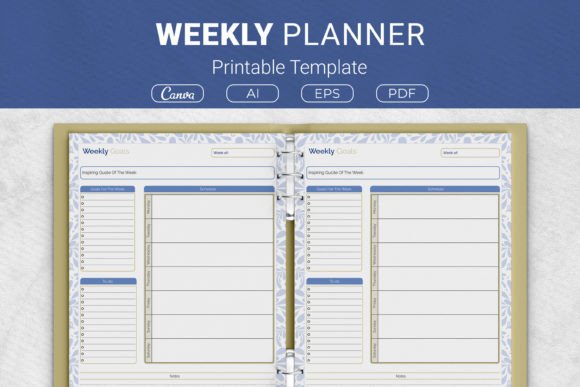
What makes a weekly goals planner effective isn't the complexity of its layout but the clarity of its prompts. This version keeps the page focused on five everyday essentials: an inspiring quote, a schedule block, a goals list, a to‑do section, and open notes. Each serves a distinct cognitive role.
- The Inspiring Quote Of The Week sits at the top, which may sound decorative but, in practice, provides a brief mental anchor before diving into logistics.
- The Schedule area doesn't demand hourly precision. It offers a clean, lined space for time‑sensitive commitments, useful whether you plan client calls, gym sessions, or family obligations.
- Goals For The Week asks you to separate outcome-oriented targets from task lists, a small but meaningful distinction that helps maintain strategic focus.
- The To‑do List handles the granular action items. When used alongside a dedicated goals block, it prevents the common mistake of treating every checkbox as a priority.
- Finally, the Notes section catches everything else: reflections, shifts in direction, unexpected ideas, or next week’s seed thoughts.
This stripped‑down structure resists feature bloat. For a planner you’re meant to print again and again, simplicity is a strength, not a compromise.
Design That Works Across Contexts
A planner’s visual presence influences how often you reach for it. The floral theme here is deliberate but not overwhelming. Soft botanical linework frames the page without crowding the functional areas. Because the artwork uses a monochrome or muted palette (the exact color often depends on how you print it), the template remains ink‑friendly and easy on the eyes during a busy Monday morning review.
The typographic hierarchy is straightforward: headings are clear, section labels are distinct, and the writing space feels generous relative to the overall footprint. This matters when you’re rapidly jotting down tasks in a meeting or during a Sunday evening planning session. Even with a flowery border, the layout doesn’t treat the user as someone who merely wants something pretty. It treats them as someone who genuinely intends to get things done.
A practical note for those printing at home: the design’s contrast holds up well on standard laser and inkjet printers. Because the floral elements are primarily outlines rather than heavy fills, you avoid the smudging and severe ink consumption that often plague highly ornate printable planners.
What the Package Includes and Why It Matters
The deliverable here isn’t a single PDF. The Weekly Goals Planner comes as a bundle that targets very different workflows. You receive native Adobe Illustrator files, an EPS file, ready‑to‑print PDFs, and a link to an editable Canva template. This multi‑format approach drastically broadens who can use the planner and how.
For graphic designers and KDP publishers, the AI and EPS files mean you’re not trapped by a fixed layout. You can adjust fonts, modify the floral elements, add a brand logo, or tweak the section labels to fit a coaching framework. The ability to edit vectors directly preserves quality at any print size and keeps the asset useful beyond its original form.
The PDF files are pre‑sized for printing without guesswork. There’s no need to fiddle with page scaling, because the templates come in several dimensions:
- US Letter (8.5 x 11 in)
- A4 (210 x 297 mm)
- 7.5 x 9.25 in
- 6 x 9 in
This size range is important. The US Letter and A4 options fit standard home and office printers. The 7.5 x 9.25 inch and 6 x 9 inch versions are common trim sizes for self‑published planners and journals on Kindle Direct Publishing. If you’re building a paperback goal journal to sell, you won’t need to reformat or risk awkward margins.
The Canva template link opens the door for non‑designers. A busy small business owner who wants to add a company quote or adjust the header font can do so in a browser without touching professional software. This also allows relatively quick duplication for creating multiple interior pages with subtle variations.
Real‑World Usability: Printing, Binding, and Daily Habits
A planner’s value is tested at the intersection of habit and physical convenience. Because this is a printable template, you control the paper stock, the binding, and the volume. That flexibility cuts both ways. On the one hand, you can print a single week at a time on crisp 32‑lb paper if you prefer a minimalist clipboard setup. On the other hand, you commit to the small ritual of printing, which might feel frictionless to some and burdensome to others.
The design is well‑suited for a binder or discbound system. The multiple size options let you match the template to an existing planner cover. For example, print the A4 version for a standard three‑ring binder, or use the 6 x 9 inch size for a compact field organizer. The margins are balanced enough that hole punching doesn’t eat into critical content, a detail often overlooked in template design.
During use, the weekly structure encourages a regular reset. The quotes section, in particular, isn’t merely decorative if you take 30 seconds to actually select a meaningful phrase each week. That act of choosing an anchor statement shifts the planner from passive tool to active mindset cue. Over a month, a consistent weekly review using the goals‑and‑to‑do split tends to surface patterns: which tasks keep moving forward, which goals stall, and where your schedule routinely underestimates time. The template doesn’t force that discipline, but it doesn’t hinder it either. That’s a fair description of a well‑designed supplementary tool.
Strengths That Emerge Over Repeated Use
When you use the same planner template for several weeks, small design decisions reveal themselves as either irritants or quiet enablers. Several strengths become apparent with this one.
The layout’s restraint makes it genuinely reusable without boredom. Floral designs in the productivity space can easily become cloying, but the botanical line art here feels more like a subtle framing device than a theme that insists on a particular mood. This allows the planner to travel across professional, creative, and personal contexts without feeling out of place.
The notes section, while simple, ends up being a catch‑all that works surprisingly hard. In practice, it captures the random “remember to check that invoice” or the emotional note “felt focused all morning — why?” Small reflective notes build a richer picture of productivity than any checkbox can, and having a dedicated space for them prevents the to‑do list from becoming a jumbled mess of tasks and commentary.
Another less obvious strength is the file bundle’s longevity. A static PDF you buy today is useful this week. Editable source files mean the planner can evolve as your workflow changes. You might, for instance, replace the “Schedule” header with “Time Blocks” after reading a time management book, or shift the goals section to use a more refined prompt like “Three Outcomes That Would Make This Week a Success.” That customizability without starting from scratch is a practical advantage not often found in fixed printable planners.
Potential Limitations to Weigh Honestly
No single template fits every personality or workflow. This Weekly Goals Planner, for all its strengths, comes with trade‑offs worth noting.
It is deliberately undated. While this makes the planner reusable indefinitely, it also places on you the responsibility of entering dates by hand or digitally. Some people strongly prefer pre‑dated planners that eliminate that step. If you’re someone who finds blank date fields a subtle barrier to starting, a separate printable or a date stamp might be a necessary companion purchase.
The floral aesthetic, while elegant, will not appeal to every user. Minimalists who want a purely utilitarian grid might find the botanical border distracting, however faint. The visual identity leans toward a warm, approachable feel, which might not align with a sterile corporate environment or with those who prefer the starkness of a bullet journal sans decoration.
The schedule section doesn’t include a formal hourly breakdown. For professionals who bill in 15‑minute increments or who manage heavily segmented days, the open schedule block may feel too loose. In such cases, the planner works better as a weekly overview alongside a more granular daily tool rather than as a standalone time‑management system.
Additionally, because the product is delivered as digital files, the physical quality of your printed planner depends entirely on your printer, paper, and binding setup. A download guarantees design quality but not the tactile experience. Anyone expecting a premium pre‑printed journal out of the box will need to invest a bit of effort or take the files to a local print shop.
Who Will Benefit Most from This Printable Planner
The people who extract the highest value from this template tend to fall into a few clear groups. Content creators, bloggers, and self‑publishing entrepreneurs looking for a KDP interior will immediately appreciate the size variations and editable source files. Being able to slightly modify a proven layout and publish it as part of a larger goal‑setting journal reduces both design costs and time to market.
Coaches, educators, and workshop facilitators can integrate the planner into client or student materials. The clean layout leaves room to add program‑specific branding or guiding questions without compromising readability. Printing a term’s worth of weeklies and distributing them in a binder creates a structured, low‑cost resource that reinforces the coaching framework.
Freelancers and remote professionals who already use a personal planner system will find this a quick, attractive way to add a weekly goal layer without overhauling their existing tools. Print a week at a time and slot it into the front of a discbound notebook, or keep a half‑year stack in a clipboard for a constantly visible planning center.
Serious hobbyists managing complex personal projects — whether that’s training for an event, planning a home renovation, or organizing a community initiative — benefit from the goals/to‑do split. That simple structural decision helps them track both the forest and the trees, reducing the chance that daily busyness obscures larger progress.
How the Template Holds Up Over the Long Term
Long‑term value in a printable planner comes from a combination of timeless design, adaptive source files, and a layout that doesn’t demand a specific philosophy. This Weekly Goals Planner scores well across those measures. The floral theme, while currently on‑trend, relies on a classic botanical style that tends not to date as quickly as bold typography or heavy geometric patterns. The underlying page architecture is sound: logical section placement, good white space, and legible text flow.
Because you can edit the vector files, a single purchase can support multiple projects over several years. A life coach might adapt a version for one‑on‑one clients, another for group workshops, and a third for a self‑published productivity journal — all from the same root design. That scalability transforms the planner from a one‑time printable into a reusable design asset.
For personal use, the habit of weekly planning gains momentum when the tool doesn’t fight you. The template’s consistency means you spend less time reorienting each week and more time actually thinking about what matters. Over months of use, the quotes you select can become a personal anthology, and the notes sections accumulate a quiet record of growth that a purely digital to‑do app rarely captures.
In a market saturated with digital productivity tools, the tangible act of printing a single page each week, writing on it, and keeping it visible can reset your attention in ways notifications cannot. The floral design adds a touch of warmth that makes the ritual feel less like data entry and more like a deliberate pause. That shift in experience is difficult to measure, but it often makes the difference between a planner that gathers dust and one that gathers meaning.