Flowers Coloring Pages: A Canvas for Calm, Creativity, and Connection
There’s a quiet kind of magic that happens when a hand picks up a crayon and begins to trace the outline of a petal. Whether it’s a six‑year‑old discovering the joy of filling a rose with pink and purple, or a busy parent stealing ten minutes of stillness while shading a lotus, flowers coloring pages open a door that feels both timeless and urgently needed. They aren’t just simple line drawings on paper—they are invitations to slow down, to play, and to make something beautiful without pressure.
In a world that often moves too fast for small hands and busy minds, a set of floral designs can become a gentle tool that works across age groups, professions, and even business models. The same page of daisies that soothes a toddler before nap time can help a stressed office worker reset after lunch, or serve as the foundation of a high‑content book on Amazon. It all starts with a few petals and a willingness to press pigment onto paper.
Why Floral Imagery Resonates So Deeply
Flowers are universally understood. A child who has never left their neighborhood still knows what a sunflower looks like. An adult who hasn’t drawn since grade school still remembers the curve of a tulip. That instant recognition makes flowers coloring pages uniquely inviting—there’s no intimidation, only familiarity. Unlike fantasy creatures or intricate mandalas that might feel too complex, a simple lily or a cluster of wildflowers whispers, “You can do this.” That low barrier to entry matters enormously when introducing art to young learners, or when someone simply wants to unwind without a learning curve.
Beyond recognition, flowers carry emotional weight. A daisy can mean innocence. A rose can speak of love or gratitude. A lotus can symbolize peace. When a person colors these shapes, they aren’t just filling outlines—they’re engaging with quiet symbolism, often without even realizing it. That subtle layer makes the activity richer and more interesting every time you sit down with a fresh page.
For the Young Learner at Home: More Than Just Keeping Busy
Parents often reach for coloring pages during rainy afternoons or long car rides, but the real treasure lies inside the motor skills and mental muscles that get exercised during the seemingly simple act of coloring. A five‑year‑old gripping a crayon and trying to stay inside the lines of a tulip is actually laying down essential handwriting foundations. The repetitive motion builds fine motor control. The need to select colors and decide how to fill a space strengthens problem‑solving and decision‑making. And when a child finishes a page and holds it up with pride, that burst of self‑esteem is irreplaceable.
With flowers coloring pages, you can easily adapt the difficulty. Use the same sunflower outline for a toddler who scribbles joyfully and a seven‑year‑old who is ready to experiment with blending, shading, or even adding a hand‑drawn sky in the background. Because the subject matter is so forgiving, mistakes become “texture” and a crooked stroke just becomes part of the stem’s charm. This forgiving nature protects the young learner from frustration while still teaching the act of completing a task—something that matters deeply in early childhood development.
Some families build evening rituals around a single page. After dinner, a child might color one zinnia while a parent reads aloud. The hands are occupied, the mind receives the story, and the stress of the day melts away. In the morning, that finished artwork can be clipped to the fridge or tucked into an envelope for grandma—turning a simple download into a connection that reaches far beyond the kitchen table.
In the Classroom or Therapy Room: A Quiet Power Tool
Educators and therapists know that not all learning happens through lectures or structured exercises. Sometimes the most profound breakthroughs come during unstructured creative time. Flowers coloring pages slide effortlessly into a sensory corner, a calm‑down kit, or a rainy‑day indoor recess activity. A second‑grade teacher might print ten copies of a daffodil page and scatter a box of colored pencils, and suddenly the room shifts from chaos to contented focus. No instructions needed.
Occupational therapists frequently use coloring to work on finger strength, bilateral coordination, and visual‑perceptual skills. Flowers offer a sweet bonus: the natural variety of shapes—long petals, tight rose spirals, broad sunflower centers—lets a therapist target different movements intentionally. A child working on pincer grasp might benefit from coloring tiny daisies in a bouquet, while another working on fluid wrist motion might flourish with large, sweeping lily petals. The same flower pack can serve multiple therapeutic goals without ever feeling clinical.
Counselors and play therapists also lean on floral coloring as a gentle emotional outlet. A page full of blossoms can become a safe space where a child names their feelings by the colors they choose. A red rose might be anger, a blue morning glory might be sadness, and a yellow buttercup might be a hope they can’t yet put into words. The simple act of sharing their finished page often opens a conversation that direct questioning could never unlock.
Adult Mindfulness and the Unexpected Pause
Ask anyone who rediscovered coloring in adulthood and they’ll tell you: it feels nothing like the rushed art classes of childhood. The slow, repetitive motion of filling a flower petal acts almost like a visual mantra. The mind stops chasing the to‑do list and settles into the rhythm of the pencil or fine‑tip marker. Flowers coloring pages specifically offer an added layer of calm because the subject matter itself is serene—no sharp edges, no busy patterns that overwhelm. Just organic curves and botanical softness.
Many adults now keep a small folder of printed floral pages in their desk drawer at work. During lunch, instead of scrolling social media, they pull out a page and a set of markers. For ten minutes, they shade a cluster of lavender or a magnolia bloom, and the mental reset is real. This isn’t just anecdotal; studies have shown that structured coloring of pre‑drawn designs can reduce anxiety and improve focus. The predictability of the flower outlines provides just enough guidance to keep the mind anchored, while the color choices allow for complete personal expression.
Couples and families also find these pages a surprising foil for togetherness. A “coloring date night” with two copies of the same floral bouquet might sound quaint, but it gently strips away the pressure to perform or produce interesting conversation. People talk more freely when their hands are busy. They laugh when their color choices clash. And at the end, they have two slightly different versions of the same flowers—a lovely metaphor for perspective.
The Entrepreneurial Angle: From Simple Page to Passive Income
Many people who download flowers coloring pages are actually building something much larger than a quiet afternoon. The rise of Amazon’s Kindle Direct Publishing (KDP) has turned printable coloring interiors into a legitimate source of passive income, and flowers remain one of the most beloved, evergreen niches. A ready‑to‑use PDF file that’s been thoughtfully formatted changes everything for a KDP seller. Instead of hiring an illustrator or spending weeks learning design software, they can focus on cover creation, pricing, and marketing—the parts that actually make or break a book’s success.
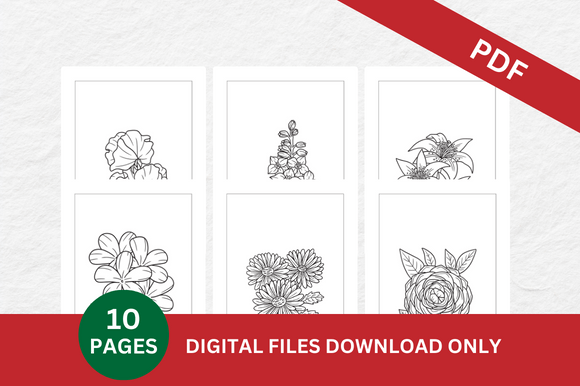
Consider this: a single PDF file containing 10 unique flower art designs, sized perfectly at 8.5 by 11 inches with no bleed, print‑ready and fully tested in KDP. That exact specification might sound technical, but for someone trying to upload their first coloring book, it’s pure gold. The dimensions match KDP’s trim size expectations, removing the fear of rejected files. The no‑bleed layout means no worrying about important art getting trimmed off during printing. And the PDF itself is already prepared for print, so there’s no conversion guesswork. You simply download it, check that it aligns with your vision, and you’re ready to go.
Who benefits from that? Stay‑at‑home parents looking to create an extra revenue stream. Artists who want to test a floral niche without drawing from scratch. Retirees who have always wanted to publish their own book but lack graphic design skills. College students building a side hustle between classes. For each of these people, the value isn’t in the number of pages—it’s in the hours saved, the frustration avoided, and the ability to launch something real this week, not next year.
Of course, 10 designs isn’t a massive coloring book on its own, but it’s an intentional starter or a bolt‑on. Combine these floral pages with another pack, add a few simple puzzles, or use them as the heart of a themed activity book for adults or kids. The flexibility of having a clean, professionally formatted core lets you experiment without huge risk. If your “Flowers for Focus” book takes off, you’ve proven the concept. If not, you’ve learned something valuable without exhausting your resources.
Practical Considerations Before You Download
Not all printable coloring files are created equal, and it’s worth pausing to think about what you truly need. If you’re a parent printing at home, you’ll want crisp black lines on white backgrounds that don’t smudge when little hands color with markers. If you’re a KDP publisher, you need to be certain the file is indeed print‑ready—no stray cut lines, no hidden bleed marks that will throw off Amazon’s printers. A PDF that’s been specifically tested in KDP, like the one described with 10 pages, 8.5 x 11 inches, no bleed, gives you exactly that confidence.
Also think about usage limits. The flower pages you print for your living room might become torn, spattered with glue, or proudly displayed with a glitter explosion—that’s part of the charm. But if you’re a teacher, you might want to print the same marigold page twenty times for a classroom project. A downloadable PDF that allows unlimited printing from a single purchase is critical here. Similarly, an entrepreneur adding these to a commercial product needs to know they have the right to use the files in their book interiors. Always verify the terms, but a well‑crafted offer typically grants the commercial license needed for KDP and other print‑on‑demand uses.
One potential limitation is page count. Ten pages might feel lean if you’re hoping for a standalone coloring book that’s thick and substantial. However, it’s also an advantage: you can test the niche without overcommitting. Merge it with other floral sets, or build your book with a mix of complexity—some simple blooms for relaxation and a few more detailed botanical arrangements for advanced colorists. That kind of thoughtful pacing inside a book often gets better reviews than a monotone set of 100 flowers.
Colorists themselves might also notice the style. These particular pages are pure black‑and‑white line art, no bleed, which means they print cleanly but don’t come with shading or grey tones. For a beginner, that’s ideal because it eliminates confusion about what to color. For an advanced colorist who loves blending and layering, the open spaces are a welcome invitation to add their own depth. There’s no “right” way to approach it; it just depends on what kind of coloring experience you’re seeking.
Ways to Extend the Life of a Single Floral Page
Beyond the obvious crayon‑to‑paper path, a set of flowers coloring pages can seed all kinds of creative re‑use. Here are a few paths that experienced teachers, crafters, and parents often take:
- Turn the finished coloring into a handmade card for Mother’s Day, a birthday, or just because. A child’s scribbled rose on the front, a hand‑written message inside—instant heirloom.
- Use the pages as tracing templates. Lay a clean sheet over a printed blossom and learn to draw flowers by tracing the outlines, then color the traced version.
- Cut out individual colored flowers and glue them onto a large sheet of paper to create a collaborative garden mural. This works beautifully in classrooms or at family reunions.
- Laminate the black‑and‑white pages and use them as reusable dry‑erase coloring mats. Great for road trips or waiting rooms.
- Experiment with different mediums on the same design: one day crayon, another day watercolor pencil, another day simple markers. Each medium teaches a different lesson about pressure, blending, and color theory.
Each of these ideas amplifies the value of that initial PDF download. Suddenly ten pages aren’t just ten pages—they’re the launchpad for dozens of projects, giftables, and learning moments.
Finding Your Own Rhythm with Floral Coloring
Maybe you’re here because you remember the smell of a fresh box of crayons and the joy of a brand‑new coloring book. Maybe you’re a grandmother looking for a quiet activity to share with a grandchild over video chat, mailing a few printed pages in advance. Or perhaps you’re a KDP seller who simply needs reliable, ready‑to‑print floral interiors to round out a new release. In all of these cases, flowers coloring pages offer a bridge between what’s simple and what’s meaningful.
The specification mentioned earlier—8.5 by 11 inches, 10 unique arts, no bleed, print‑ready PDF—is more than a checklist. It’s a quiet promise of reliability. The pages are sized exactly right for a standard home printer or a KDP‑bound book. The absence of bleed means you won’t lose a single petal to a trim line. And because the file comes as a single, tested PDF, you don’t have to wonder about formatting or conversion. You can take that file and immediately turn it into a morning ritual, a classroom resource, or a product for sale.
Ultimately, the flowers themselves do the heavy lifting. They don’t demand skill, only presence. A child colors them and learns. An adult colors them and breathes. An entrepreneur publishes them and earns. It’s a rare resource that can sit at the intersection of all three without straining, and that’s exactly what a well‑designed set of floral coloring pages can become—a quiet, steadfast tool that keeps giving back every time someone picks up a color and begins.