Evaluating an Order Tracker KDP Interior for Your Publishing Workflow
Publishers who build low-content and medium-content books for Amazon KDP often weigh the choice between designing from scratch and using a ready-made interior. An Order Tracker KDP Interior sits firmly in the ready-made category, offering a structured page set that can reduce production time significantly. This article examines what that package actually contains, the practical upsides and natural limitations, and the circumstances where it serves a publisher well—or where a different approach might be a better fit.
What an Order Tracker KDP Interior Package Typically Provides
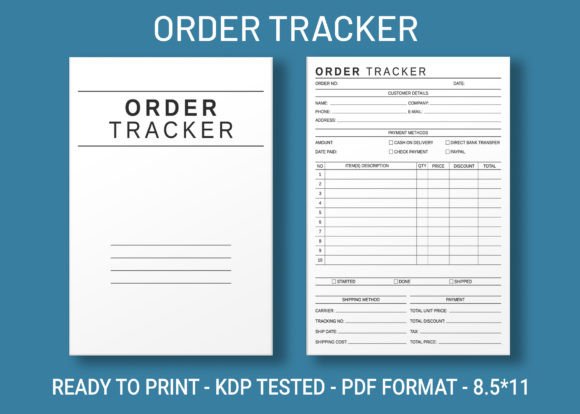
The product in question is a digital file bundle designed to function as the interior of an order tracking logbook. When you purchase a package described as an Order Tracker KDP Interior, you are not buying a finished book, but rather a collection of pre-designed pages ready for submission to Kindle Direct Publishing. Typically, the bundle includes:
- An editable source file in Adobe Illustrator (AI) format
- High-resolution PDF files prepared for print
- High-resolution PNG files for additional flexibility
- A page size of 8.5 by 11 inches, one of the most common trim sizes for KDP paperbacks
- A total of 120 pages, counted as interior sheets
- A dedicated intro page that can serve as a title or welcome spread
- Bleed settings already applied, meaning the file is configured to extend images or backgrounds past the trim edge
- Confirmation that the interior has been KDP tested, reducing compatibility surprises during the upload process
Because the file is with bleed, publishers avoid the common mistake of uploading a no-bleed interior for a design that needs edge-to-edge coverage. The KDP testing claim suggests that the file passed Amazon’s automated and manual review checkpoints, which helps prevent rejections tied to formatting errors.
Why Self-Publishers Consider a Pre-Made Interior
The primary appeal of a ready-to-upload interior is speed. Instead of building an order tracker layout from scratch—adjusting margins, testing bleed, repeating for 120 pages—you download a package that is already composed. For someone managing multiple KDP titles, this shortcut can mean publishing a new book in hours rather than days.
Consistency is another factor. The file bundle provides a unified visual theme across all pages, including headers, lines, and any decorative elements. That consistency is often harder to achieve when piecing together fragments from different sources or using generic tools without a cohesive design vision.
There is also a learning-curve benefit. Not every publisher is comfortable working inside Adobe Illustrator to build print-ready PDFs that meet KDP’s technical specifications. A pre-tested interior removes much of that friction. Even the inclusion of PNG files gives users the option to drop pages into simpler software like Canva or PowerPoint, though that method may lose some vector crispness.
Time Efficiency and Workflow Acceleration
Taking a 120-page interior and customizing only the intro page or cover allows a publisher to list a new product on Amazon quickly. For individuals building a large catalog of logbooks, journals, and trackers, this efficiency can multiply output without sacrificing baseline quality.
Reduced Technical Friction
The bleed-ready configuration is particularly valuable. KDP’s bleed requirements—typically 0.125 inches on each side—must be set correctly during document creation. Pre-configured files minimize that step. Combined with KDP testing, the package lowers the chance that an interior returns a formatting error after upload, a frustration many first-time publishers face.
Editable Source File Extends Flexibility
While the interior is complete, the AI file means you are not locked into the exact layout forever. You can adjust fonts, move table lines, or modify the branding. This is a middle ground between a completely fixed template and a true custom design. For a publisher who values some level of control without starting from zero, the editable vector file adds meaningful value.
Standard Dimensions and Page Count
The 8.5 × 11 inch format matches popular composition and workbook sizes, which makes the finished book feel familiar to buyers. At 120 pages, the product fits a comfortable mid-range page count that balances perceived value with manageable print costs for the end customer. The intro page also gives the book a professional start, something that simple template generators sometimes omit.
Fixed Design Limits Niche Targeting
An interior created for “order tracking” implies a specific structure: columns for order numbers, dates, customer names, item details, and status. That works well if your target audience needs exactly that format. However, if you plan to sell the book to a broader audience that tracks inventory, appointments, or daily tasks, the pre-determined layout may feel misaligned. You cannot easily repurpose a dedicated order tracker into, say, a general-purpose logbook without significant rework.
Page Count Rigidity
The interior contains exactly 120 pages. While you can duplicate or delete pages in the AI file, that requires manual editing and a new export process, which somewhat reduces the “ready-to-upload” advantage. For publishers who prefer to offer 100-page or 150-page versions as product variations, the fixed count means extra steps.
Software Requirements for Full Editing
The editable AI file demands a working copy of Adobe Illustrator or a compatible vector editor. If your workflow relies only on basic tools, the potential to customize remains theoretical. In that case, you are mostly limited to using the finalized PDF. This is not a drawback of the product itself, but a compatibility note that shapes its real-world usefulness.
Market Saturation and Differentiation
Ready-made interiors, especially those sold widely on creative marketplaces, may be used by multiple publishers. This increases the chance that similar or identical interiors appear across different Amazon listings. While the KDP interior itself may be well-constructed, a book’s success also depends on cover design, title strategy, and niche positioning—elements that remain entirely the publisher’s responsibility.
When This Interior Makes Perfect Sense
Consider an Order Tracker KDP Interior a strong fit in several scenarios. If you are a new publisher who wants to bypass the steepest part of the formatting learning curve, a tested, bleed-ready file removes significant uncertainty. You can focus on creating a compelling cover and listing optimization. The package also works well for experienced publishers who need to fill a gap in their product line quickly: a seller who already offers a meal planner and a budget workbook might add an order tracker as a logical extension without investing days in design.
The interior is especially practical when your business model centers on volume. Suppose you plan to launch a series of low-content books with similar formatting but different covers. Using a reliable interior template across multiple projects can standardize quality and reduce editing time. The editable AI file even allows you to swap brand colors or adjust header text for each variation, maintaining some uniqueness.
Additionally, if you already sell on Etsy and want to expand to Amazon KDP with a complementary physical product, a ready-made order tracking logbook interior bridges that gap efficiently. The 8.5 × 11 inch size mirrors common printable formats, so customers familiar with your digital products will find the printed version intuitive.
When Alternatives Might Be Worth Exploring
If you possess moderate to advanced design skills and your creative vision is highly specific, building the interior yourself may yield a more differentiated result. Custom layouts allow you to mimic established brand aesthetics, include proprietary charts, or tailor the page design to a sub-niche that pre-made templates do not cover—say, a tracker specifically for candle-making supply orders or handmade jewelry vendors.
When your target audience expects extreme personalization, alternatives such as hiring a layout designer or commissioning a unique interior might justify the higher cost. A one-of-a-kind interior can become part of your brand identity, something a widely-available digital product cannot replicate.
Publishers who frequently adjust page counts for pricing optimization should also weigh the effort. If you plan to A/B test 100-page, 120-page, and 150-page versions to find the best price point, a single fixed interior does not directly support that test. You would need to modify the source file each time, which blurs the line between ready-made and custom.
Free tools like Canva or Affinity Publisher templates can also serve as starting points. These options demand more assembly work but cost nothing. For a publisher testing a niche with no upfront budget, a free route may be more sensible than purchasing a digital file, even at a low price.
Decision-Making Insights for Self-Publishers
Before adding an Order Tracker KDP Interior to your toolkit, clarify what you truly need. Ask whether 120 pages of a specific order tracking layout match the audience you intend to serve. Consider how much time you realistically want to spend on formatting vs. marketing. If formatting feels like a bottleneck, a pre-built interior solves a tangible problem. But if you enjoy the design process and want full creative ownership, using a template may feel limiting over time.
Evaluate the technical environment you work in. If you have Adobe Illustrator and the skills to work with vector files, the editable AI file becomes a genuine asset. If you do not, assess whether the PDF alone provides enough value. The PDF is still fully usable and ready to upload, so you lose only the deep customization layer, not the core functionality.
Also think about scalability. A publisher planning to release ten different trackers this quarter might benefit from a library of ready-made interiors, where this order tracker becomes one piece of a larger puzzle. In that context, the time saved per book multiplies quickly, and the one-time cost is offset by the volume of output.
Ultimately, the decision hinges on balancing creative control with practical speed. An Order Tracker KDP Interior is a dependable shortcut for its intended use case. It is not a universal solution but a focused tool. When your publishing goals and technical resources align with what the package offers, it can remove friction that otherwise slows down the self-publishing process.